Maui Million Dollar Home Sales ($1.0M+) – Day 6 of 10 – “How much land do they have?”

From January 1, 2012 through September 16, 2013, a total of 231 “million dollar plus” homes sold in Maui County, generating total volume in excess of $525 million.  There are many ways that Hawaii real estate appraisers analyze sales statistics for luxury homes.  Because a proper market study for this segment would run many pages, I am posting one article per day for ten days.

Day 6 of 10 – Maui Million Dollar ($1.0M+) Single Family Homes By Land Area

Consider the following graph, which categorizes the Maui million dollar home sales by their lot sizes:
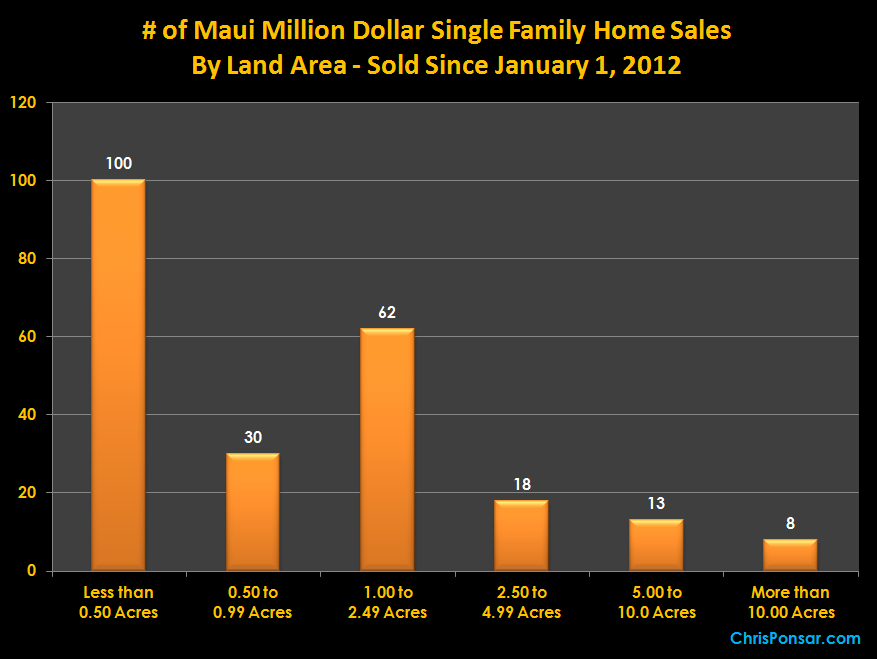
Maui Million Dollar Home Sales By Land Area

Maui Million Dollar Home Sales By Land Area

If you are unfamiliar with the luxury home market in Hawaii, the data presented on this graph might be counter-intuitive.  As  shown, most million dollar home sales are on lots that are smaller than half an acre in size, and only a handful of transactions are on tracts larger than ten acres.

Bottom Line: Once Again, Bigger Isn’t Necessarily Better

Not many people would argue that, all things being equal, more land area is usually better.  But on Maui and throughout the Hawaii high-end residential sector, an experienced real estate appraiser understands that beach frontage and ocean views are the primary drivers of market value.  Since near-ocean properties are typically subdivided into smaller land area configurations, it is easy to see how the most common high-dollar sales have smaller lots.

Questions or comments?  Please leave them in the comment  box below, I would be happy to clarify and/or expand.

Aloha, Chris
Maui Million Dollar Home Sales ($1.0M+) – Day 5 of 10 – Price Per Square Foot

From January 1, 2012 through September 16, 2013, a total of 231 “million dollar plus” homes sold in Maui County, generating total volume in excess of $525 million.  There are many ways that Hawaii real estate appraisers analyze sales statistics for luxury homes.  Because a proper market study for this segment would run many pages, I am posting one article per day for ten days.

Day 5 of 10 – Maui Million Dollar ($1.0M+) Single Family Homes By Price Per Square Foot Of Living Area

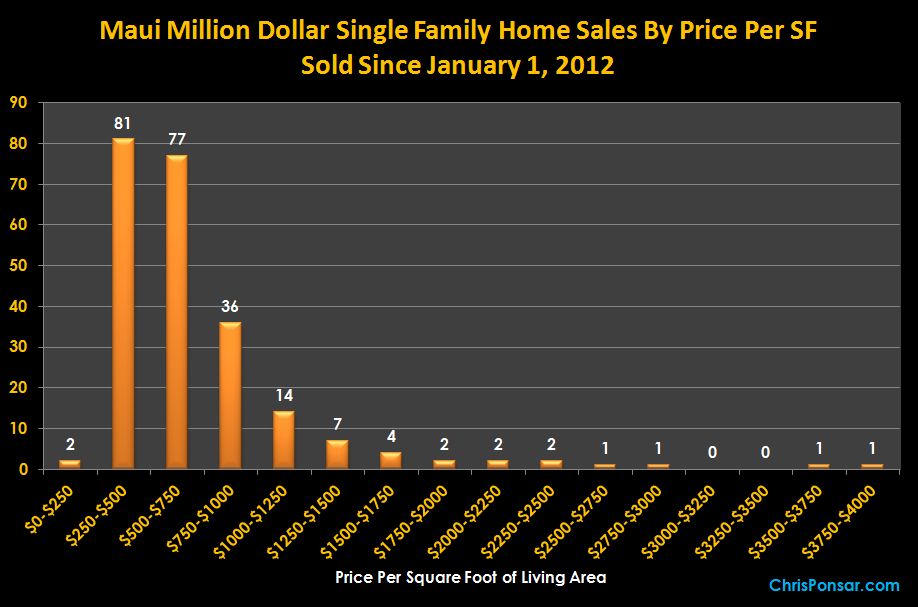
Consider the following graph and chart, which measures each of the million dollar sales divided by their respective living areas in square feet:

Maui Million Dollar Sales By Price Re Square Foot

Maui Million Dollar Sales By Price Per Square Foot


Island of Maui Million Dollar Single Family Homes By Price Per Square Foot Of Living Area
Sold From 1/1/2012 through 9/16/2013
Price Per Square Foot # of Sales % of Total
$0-$250 2 0.9%
$250-$500 81 35.1%
$500-$750 77 33.3%
$750-$1000 36 15.6%
$1000-$1250 14 6.1%
$1250-$1500 7 3.0%
$1500-$1750 4 1.7%
$1750-$2000 2 0.9%
$2000-$2250 2 0.9%
$2250-$2500 2 0.9%
$2500-$2750 1 0.4%
$2750-$3000 1 0.4%
$3000-$3250 0 0.0%
$3250-$3500 0 0.0%
$3500-$3750 1 0.4%
$3750-$4000 1 0.4%
Total 231 100.0%

More than 90 percent of Maui’s million dollar home sales in the study period fall in the “price per square foot” range of $250 to $1,250, with the $250 to $1,000 range accounting for 84 percent of the transactions.

Maui real estate agents that are active in the luxury sector report that the high-end/luxury market typically begins at the $1,000 per square foot level.  The sub-$1,000 data shows how raw demand for Maui residences generates a great number of high dollar ($1.0 M plus) sales for “less-than-luxury” homes.

The two sales that cleared the $3,000 per square foot level did so for different reasons: one was a prime white sand beach home on South Kihei Road that sold for $23.0 million.  The other was an older/smaller cottage on an amazing 1.1 acre oceanfront lot near Paia–the high price per square foot of living area was due to the largely insignificant improvements on a very valuable piece of land.

Bottom Line: At least on Maui, a million bucks doesn’t go as far as it used to.

At these prices, it is easy to see how a Maui real estate appraiser could be regularly confronted with homes that sell for prices that easily exceed Fannie Mae, Freddie Mac, and FHA conforming loan limits.

Questions or comments?  Please leave them in the comment  box below, I would be happy to clarify and/or expand.

Aloha, Chris

Maui Million Dollar Home Sales ($1.0M+) – Day 4 of 10 – “Who Sold Them”?

From January 1, 2012 through September 16, 2013, a total of 231 “million dollar plus” homes sold in Maui County, generating total volume in excess of $525 million.  There are many ways that Hawaii real estate appraisers analyze sales statistics for luxury homes.  Because a proper market study for this segment would run many pages, I am posting one article per day for ten days.

Day 4 of 10 – Maui Million Dollar ($1.0M+) Single Family Homes By Agent

Consider the following graph and chart, 24 agents have sold four or more “million dollar homes” in the study period (ties sorted by first name alphabetical order):

Maui Million Dollar Home Sales By Agent

Maui Million Dollar Home Sales By Agent

Maui Million Dollar Single Family Home Sales By Agent
Sold From 1/1/2012 through 9/16/2013

Rank

Agent Name
# of
$1.0M+ Sales
1 Wendy R Peterson 11
1 William B Moffett Jr. 11
3 Robert H Dein 10
4 Mary Anne Fitch 8
5 Lori L Powers 7
5 Robert R Myers 7
5 Tom Tezak 7
8 John H Page-Papazian 6
8 Steve Blackington 6
10 Bob Hansen 5
10 Debbie Arakaki 5
10 Dennis Rush 5
10 Jeremy Stice 5
10 Martin Hauen-Limkilde 5
10 Nancy J Callahan 5
10 Vincent Palmieri 5
17 Courtney M Brown 4
17 Cynthia Warner 4
17 Dano Sayles 4
17 Diane K Pool 4
17 Jeannie Kong 4
17 Josh Jerman 4
17 Kathy Ross 4
17 Riette G Jenkins 4

Bottom Line: This is the big time.

No analysis required.  This data speaks for itself.  We’re talking about real estate professionals at the top of their game here.  They all deserve aloha and praise!

Questions or comments?  Please leave them in the comment  box below, I would be happy to clarify and/or expand.

Aloha, Chris
Maui Million Dollar Home Sales ($1.0M+) – Day 3 of 10 – “How Big Are They?”

From January 1, 2012 through September 16, 2013, a total of 231 “million dollar plus” homes sold in Maui County, generating total volume in excess of $525 million.

There are many ways that Hawaii real estate appraisers analyze sales statistics for luxury homes.  Because a proper market study for this segment would run many pages, I am posting one article per day for ten days.

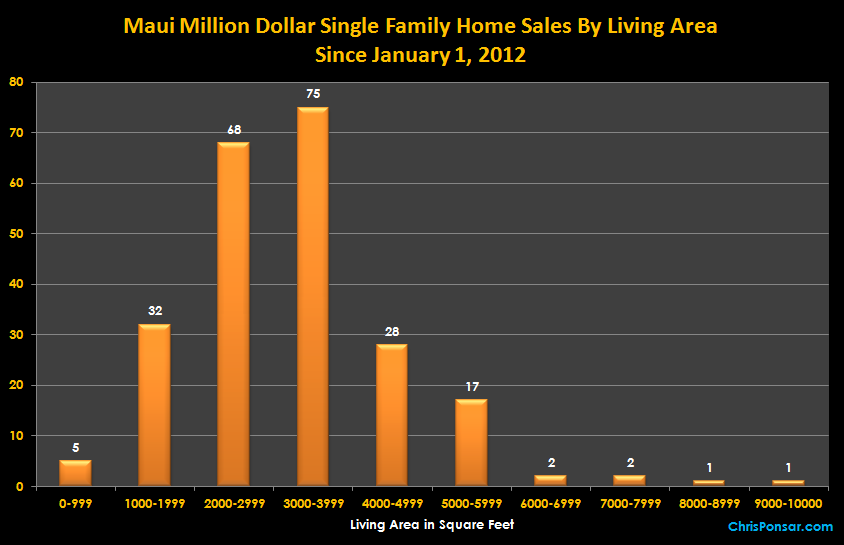
Day 3 of 10 – Maui Million Dollar ($1.0M+) Single Family Homes By Living Area

Consider the following graph and chart:

Maui Million Dollar Sales By Living Area

Maui Million Dollar Sales By Living Area

Maui Million Dollar Single Family Homes By Living Area
Sold From 1/1/2012 through 9/16/2013
Living Area in SF # of Sales % of Total
0-999 5 2.2%
1000-1999 32 13.9%
2000-2999 68 29.4%
3000-3999 75 32.5%
4000-4999 28 12.1%
5000-5999 17 7.4%
6000-6999 2 0.9%
7000-7999 2 0.9%
8000-8999 1 0.4%
9000-10000 1 0.4%
Total 231 100.0%

Luxury homes having between 2,000 and 4,000 square feet of living area represent the “sweet spot” of the Maui luxury market, comprising more than 60 percent of the Valley Isle’s million dollar home sales since the beginning of 2012.

Bottom Line: Bigger Isn’t Necessarily Better

97.4 percent of all “million dollar plus” single family homes sold on Maui since 2012 have 6,000 square feet of living area or less.  While it is certainly possible to build larger residences, and some very wealthy individuals have, if you’re building much larger than 5,000 square feet, you might be going beyond what the market prefers.

Questions or comments?  Please leave them in the comment  box below, I would be happy to clarify and/or expand.

Aloha, Chris

Bonus  – Superadequacy

The data above suggests that building much larger than 5,000 square feet may not be consistent with market preferences.  If true, real estate appraisers refer to this phenomena as a “superadequacy”, which is defined below:

superadequacy

An excess in the capacity or quality of a structure or structural component; determined by market standards.

Source: Appraisal Institute, The Dictionary of Real Estate Appraisal, 5th ed. (Chicago: Appraisal Institute, 2010

Maui Million Dollar Home Sales ($1.0M+) – Day 2 of 10 – Sale Prices

From January 1, 2012 through September 16, 2013, a total of 231 “million dollar plus” homes sold in Maui County, generating total volume in excess of $525 million.

There are many ways that Hawaii real estate appraisers analyze sales statistics for luxury homes.  Because a proper market study for this segment would run many pages, I am posting one article per day for ten days.

Day 2 of 10 – Maui Million Dollar ($1.0M+) Single Family Homes By Sale Price

Consider the following graph and chart:

Maui Million Dollar Homes By Sale Price

Maui Million Dollar Homes By Sale Price

Maui Million Dollar Single Family Homes By Sale Price
Sold From 1/1/2012 through 9/16/2013
Sale Price # of Sales % of Total
$1.0 M to $1.9 M 157 68.0%
$2.0 M to $2.9 M 31 13.4%
$3.0 M to $3.9 M 18 7.8%
$4.0 M to $4.9 M 9 3.9%
$5.0 M to $5.9 M 5 2.2%
$6.0 M to $6.9 M 2 0.9%
$7.0 M to $7.9 M 1 0.4%
$8.0 M to $8.9 M 4 1.7%
$9.0 M to $9.9 M 3 1.3%
More than $10.0 M 1 0.4%
Total 231 100.0%

The data shows a predictable trend, with more than 80 percent of the “one million plus” sales on Maui being in the “under $3.0 million” price range.  Although a handful of high profile Maui luxury homes have sold in the past few years for prices in excess of $20.0 million, MLS records show only one residence eclipsing $10.0 million since January 1, 2012.

Bottom Line: Price Matters

There is healthy market activity in Maui’s “million dollar plus” category, but the overwhelming majority of sales (nearly 90 percent) sold for less than $4.0 million.

Questions or comments?  Please leave them in the comment  box below, I would be happy to clarify and/or expand.

Aloha, Chris
Maui Million Dollar Home Sales ($1.0M+) – Day 1 of 10 – “Where are the million dollar homes located?”

Since January 1, 2012, a total of 231 “million dollar plus” homes have sold in Maui County, generating a total dollar volume in excess of $525 million.

There are many ways that Hawaii real estate appraisers analyze luxury sales statistics.  Because a proper market study for this segment would run many pages, I will be posting one analysis per day for the next ten days.

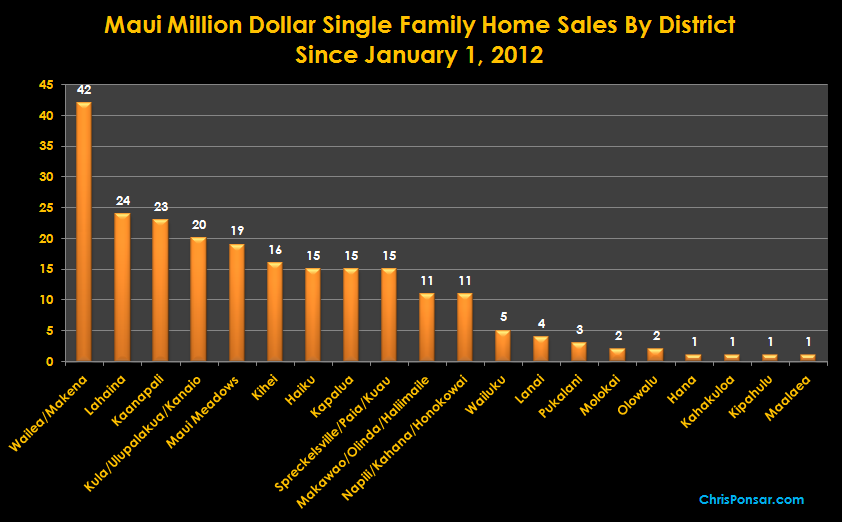
Day 1 of 10 – Maui Million Dollar ($1.0M+) Single Family Homes By District

Consider the following graph and chart:

Day 1 - Maui $1.0M Sales By District

Maui Million Dollar Home Sales By District

Maui Million Dollar ($1.0M+) Single Family Homes By District
Sold From 1/1/2012 through 9/16/2013
District # of Sales % of Total
Wailea / Makena 42 18.2%
Lahaina 24 10.4%
Kaanapali 23 10.0%
Kula / Ulupalakua / Kanaio 20 8.7%
Maui Meadows 19 8.2%
Kihei 16 6.9%
Haiku 15 6.5%
Kapalua 15 6.5%
Spreckelsville / Paia / Kuau 15 6.5%
Makawao / Olinda / Haliimaile 11 4.8%
Napili / Kahana / Honokowai 11 4.8%
Wailuku 5 2.2%
Lanai 4 1.7%
Pukalani 3 1.3%
Molokai 2 0.9%
Olowalu 2 0.9%
Hana 1 0.4%
Kahakuloa 1 0.4%
Kipahulu 1 0.4%
Maalaea 1 0.4%
Total 231 100.0%

Maui’s three resort districts of Wailea / Makena, Kaanapali, and Kapalua are in bold.  As shown, almost 35 percent of Maui’s million dollar home sales since January 1, 2012 come from these three master planned communities. The second tier visitor areas of Lahaina, Kihei, and Napili/Kahana/Makawao log an additional 22 percent of the “million dollar” single family home sales on the Valley Isle.

Maui Resort and Second Tier Neighborhoods

Maui Resort and Second Tier Neighborhoods


Bottom line:  Location matters.

While upcountry locales are showing strong sales figures in the million dollar and above segment, Maui’s master planned resorts of Wailea/Makena, Kaanapali, and Kapalua lead the way.

Questions or comments?  Please leave them in the comment  box below, I would be happy to clarify and/or expand.

Aloha, Chris

Kauai Industrial Properties – Building Age Survey

The island of Kauai is home to some 313 industrial buildings on 237 parcels containing more than 2.5 million square feet of gross building area.

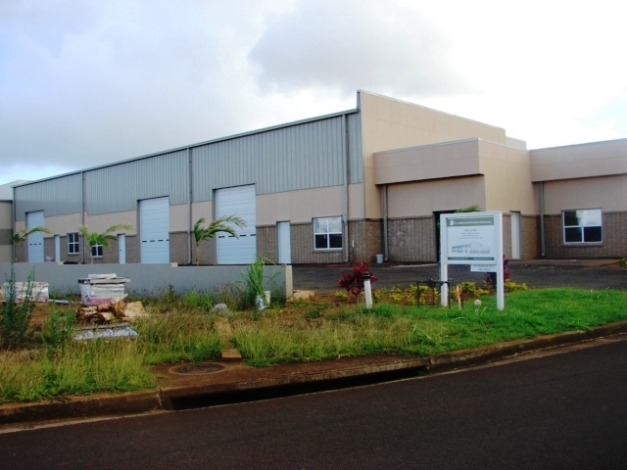
A typical industrial warehouse in Puhi, Kauai, Hawaii

A typical industrial warehouse in Puhi, Kauai, Hawaii

As shown in the table and pie chart below, nearly 90 percent of Kauai’s industrial buildings are less than 50 years old, with the oldest surviving structures being in the 70-79 year old age group.

Kauai Industrial Buildings

Zoned Limited Industrial (IL) and General Industrial (IG)

Age in Years

Count

% of Total

0-9

37

12%

10-19

57

18%

20-29

107

34%

30-39

39

12%

40-49

38

12%

50-59

9

3%

60-69

7

2%

70-79

19

6%

Total

313

100%

Kauai Industrial Buildings By Age - Pie Chart

The graph below depicts the extent of construction that took place after Hawaii became a State in 1959 (fifty-four years ago), and the large proportion of industrial buildings that were developed in the period of 1984 through 1993 (buildings aged 20 to 29).

Kauai Industrial Buildings By Age Group - Column Chart

A pdf copy of the County of Kauai Comprehensive Zoning Ordinance (CZO) can be downloaded here.

Of particular interest to Kauai industrial developers are the descriptions of the Garden Isle’s industrial districts:

(a) There are two (2) Industrial Districts:

(1) Limited Industrial (IL)
(2) General Industrial (IG)

(b) Limited Industrial shall include uses which are generally in support of
but not necessarily compatible with permissible uses in the Commercial District.

These Districts shall normally be established within reasonable accessibility and
convenience to General Commercial Districts and where there is adequate access to
a major thoroughfare.

(c) General Industrial shall include all business, industrial processing, or
storage uses that are generally considered offensive to the senses or pose some
potential threat or hazard to health, safety and welfare.

This District shall not be located adjacent to residential or resort districts unless there is physical or geographical protection from those characteristics of the uses considered to be offensive or hazardous.

If you have any questions of comments, please leave them in the comment box below.

Aloha, Chris

Hokua Luxury Condo Tower – Where are the owners from?

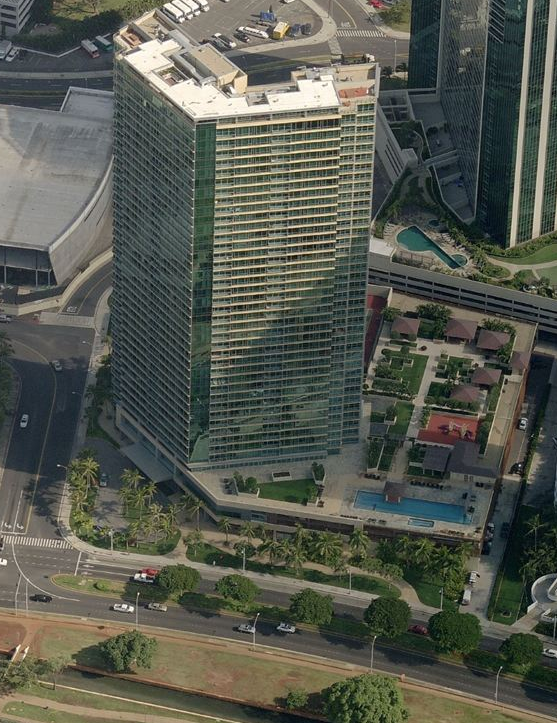
The Hokua condominium, located at 1288 Ala Moana Boulevard, is arguably Honolulu’s most prestigious high-rise address.

Hokua - Image Sourse: Bing Maps

Hokua – Image Source: Bing Maps

The 40-story tower, built in 2006 as a joint development venture between the MacNaughton Group, Kobayashi Group, and A&B Properties Inc,, sits between two highly desirable shopping destinations (Ala Moana Shopping Center to the east and Ward Center to the west), and benefits from excellent ocean views over Ala Moana Beach Park.

Where are the 248 Hokua unit owners from?

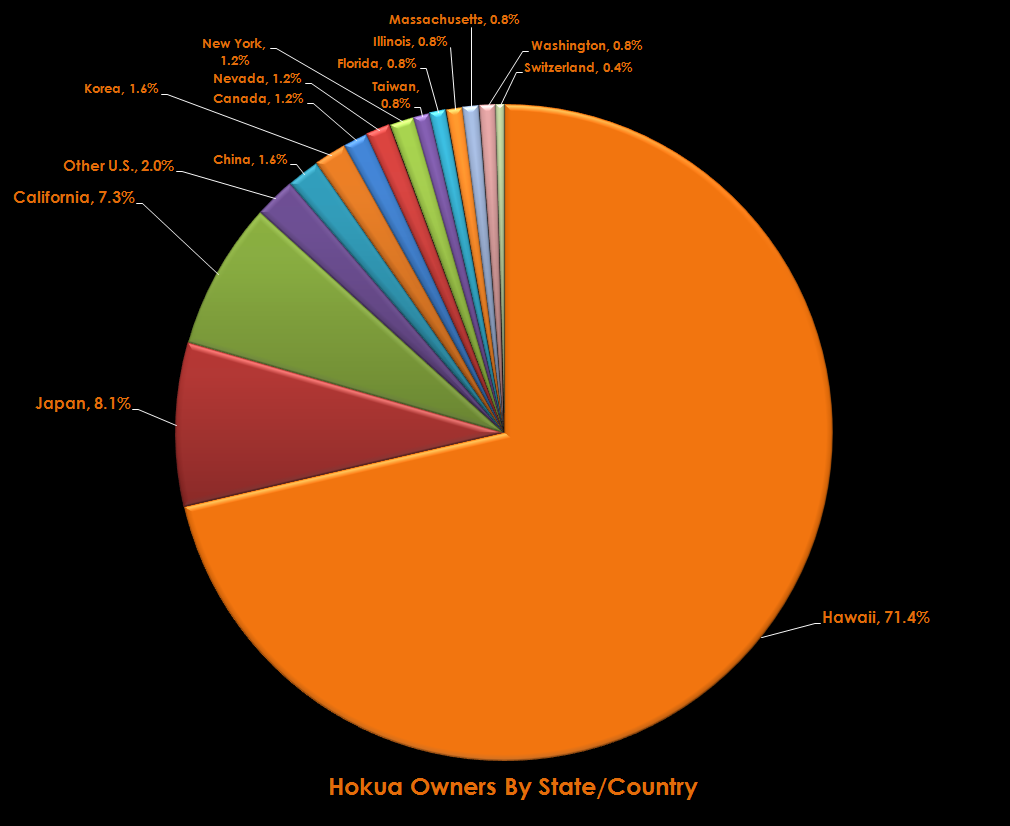
When appraisers are valuing a proposed high-rise condominium project, it is often appropriate to develop a market study that analyzes where potential purchasers are likely to come from.  According to tax records as of September 2013, Hokua units are owned by individuals from the following locales:

HOKUA UNIT OWNERS BY STATE / COUNTRY
State / Country # of Units Owned % of Total
Hawaii 177 71.4%
Japan 20 8.1%
California 18 7.3%
Other U.S. 5 2.0%
China 4 1.6%
Korea 4 1.6%
Canada 3 1.2%
Nevada 3 1.2%
New York 3 1.2%
Taiwan 2 0.8%
Florida 2 0.8%
Illinois 2 0.8%
Massachusetts 2 0.8%
Washington 2 0.8%
Switzerland 1 0.4%
Total 248 100.0%

In total, 86.3 percent of current Hokua owners are US based (71.4 percent from Hawaii) and 13.7 percent are foreign (Japan leading the pack with 8.1 percent).  These figures skew more toward Hawaii than I was expecting, although 35 or so units (about 14 percent) are owned by corporations, partnerships, LLC’s, or other entities that have Hawaii addresses, but are not necessarily controlled by owners who reside primarily in the Aloha State.  But by and large, it appears that Hokua’s reputation as the premier luxury tower for wealthy Hawaii residents is deserved.

Hokua owners by state and country

Source: Honolulu Tax Office records and Chris Ponsar, MAI

Future articles will analyze other luxury properties to see how other prestigious developments in Honolulu compare.

Questions, comments?  Please leave them in the comment box, I would be happy to clarify and/or expand.

Aloha, Chris
Superior Comps, Downward Adjustments

When real estate appraisers are using the sales comparison approach to value property, adjustments are made to account for differences in relevant property characteristics.

Over the past week I got a couple of emails about adjustments, specifically: “why are downward adjustments made to superior comparables?”

This video sorts our the concept that at first might be counter-intuitive by looking at two residential features that are common in Hawaii: Swimming Pools and Ocean Views.

Questions?  Please ask in the comment box below.

Aloha, Chris

Sales Comparison, Adjustments, and Paired Sales

This video looks at the sales comparison approach that appraisers use as the primary method to value real estate.

A few appraisal terms that are used in the video are:

Sales Comparison Approach
A comparative approach to value that considers the sales of similar or substitute properties and related market data and establishes a value estimate by processes involving comparison. In general, a property being valued (a subject property) is compared with sales of similar properties that have been transacted in the open market. Listings and offerings may also be considered. A general way of estimating a value indication for personal property or an ownership interest in personal property, using one or more methods that compare the subject to similar properties or to ownership interests in similar properties. This approach to the valuation of personal property is dependent upon the Valuer’s market knowledge and experience as well as recorded data on comparable items.

Adjustments
Mathematical changes made to basic data to facilitate comparison or understanding. When dollar adjustments are used, individual differences between comparables and the subject property are expressed in terms of plus or minus dollar amounts; with percentage adjustments, individual differences are reflected in plus or minus percentage differentials.

Paired Data Analysis
A quantitative technique used to identify and measure adjustments to the sale prices or rents of comparable properties; to apply this technique, sales or rental data on nearly identical properties is analyzed to isolate and estimate a single characteristic’s effect on value or rent. Often referred to as paired sales analysis.

Adjustment Grid
A table used to display comparable data and facilitate adjustment of differences in elements of comparison.

Comparables
A shortened term for similar property sales, rentals, or operating expenses used for comparison in the valuation process. In best usage, the thing being compared should be specified, e.g., comparable sales, comparable properties, comparable rents.

All Definitions Sourced From: Appraisal Institute, The Dictionary of Real Estate Appraisal, 5th ed. (Chicago: Appraisal Institute, 2010).

If you have any questions or comments, please leave them in the comments box below.

Aloha, Chris